









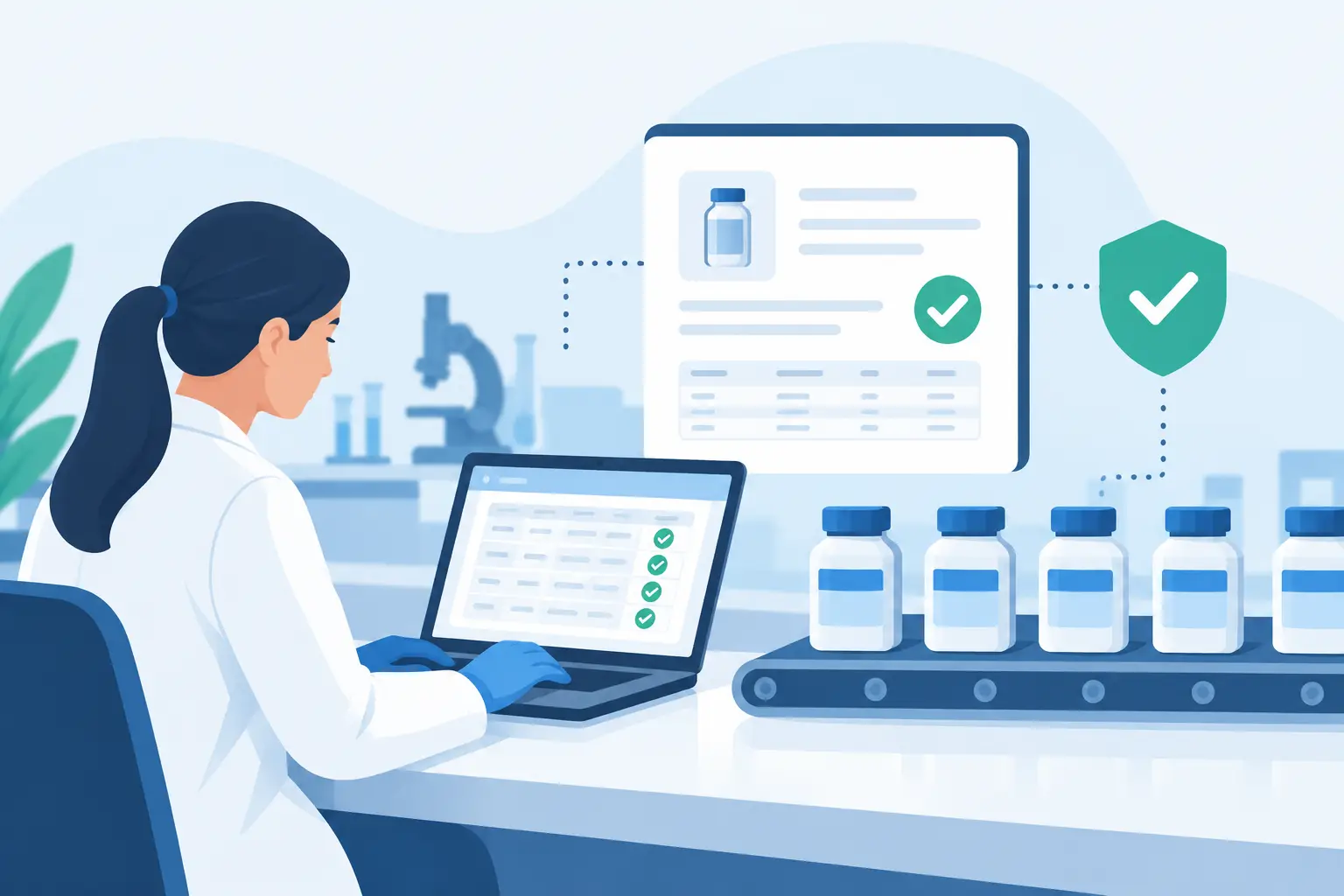
A certificate of analysis has limited value if a purchaser cannot reliably connect it to the material in hand. For research peptide buyers, digital COA systems address that point of failure by organizing lot-specific testing records, verification controls, and comprehensive quality documentation in one accountable process.
A downloadable document alone is not a verification program. It may show an analyte name, a reported purity result, and a laboratory date, but it does not necessarily establish whether the document belongs to the exact batch being purchased or received. A properly designed digital system ties the COA to a defined batch identifier and gives the purchaser a direct way to validate that relationship.
What Digital COA Systems Should Control
Digital COA systems are structured documentation environments used to publish, retrieve, and verify certificates of analysis and related batch records. Their purpose is operational: preserve a clear chain between a product listing, a lot or batch number, the applicable analytical record, and the customer verification process.
For a research-material supplier, this creates a more useful standard than a general statement that products are "tested." The relevant question is whether the supporting record is specific, accessible, legible, and attributable to the material under review. A system should allow a purchaser to locate the appropriate batch record without relying on an informal request, a generic product-level PDF, or a sales claim.
The strongest implementations treat documentation as part of the product control process. Batch information is maintained at the same level of care as catalog data, inventory status, packaging identifiers, and customer-facing verification instructions. This is especially relevant when multiple batches of the same research product may be available over time.
The Difference Between a COA File and a Verification System
A COA file is a document. A verification system is the framework that makes that document usable.
A static file can be valid, but it carries practical limits. It may be renamed, separated from its original source, or confused with a record for a different lot. It may also be difficult for customers to find after purchase. None of those issues automatically invalidate the analytical result, but they weaken traceability.
A digital verification system adds controls around the document. At minimum, it should associate a COA with a unique batch or lot identifier, retain the record in a consistent registry, and provide a clear method for matching the identifier on product packaging or order documentation to the published record. More advanced systems can also record document revisions, restrict administrative changes, and maintain an audit trail for internal quality review.
The appropriate level of control depends on the supplier's catalog size, batch turnover, and fulfillment workflow. A small operation may begin with a carefully maintained registry and controlled naming convention. A larger catalog may require database-driven batch management, role-based access, and automated record association. The principle remains the same: the purchaser should not have to guess which certificate applies.
Batch-Level Identification Is the Core Control
Product names are not sufficient identifiers. A single product can be manufactured or received across multiple lots, and results can vary within permitted specifications or according to the testing methodology used. Batch-level identification is what allows quality documentation to describe a specific material rather than a product category.
The batch number on a COA should correspond to the number shown on the applicable product label, packaging, or fulfillment record. If a customer sees an inconsistency, the right response is not to infer equivalence. The discrepancy should be reviewed through the supplier's support and quality process before the material is used for research.
This control also benefits the supplier. When a question arises about a record, packaging detail, or order, a defined batch identifier narrows the review to a traceable unit of inventory. That is more efficient than attempting to reconstruct the history of a product from a general catalog name.
What a Useful Digital COA Record Includes
A certificate must be read in context. The exact contents will depend on the material and testing program, but a useful batch record generally identifies the product, batch or lot number, test date, analytical method or test category, reported results, and the laboratory or responsible testing source. It should also include enough information to distinguish the record from other versions.
For research peptides, purchasers often review reported identity, purity, mass confirmation, and related analytical documentation. However, a reported result is meaningful only when its scope is clear. Purity percentage, for example, should be interpreted alongside the stated method, sample handling, and the certificate's connection to the correct batch. A high number on an isolated document is not a substitute for traceability.
Digital presentation should preserve the original analytical information without making the record difficult to inspect. Scans that are unreadable, cropped tables, missing pages, or generic filenames introduce unnecessary uncertainty. A quality documentation system should make records available in a stable format and label them consistently enough that customers can identify what they are reviewing.
Verification Must Be Practical, Not Merely Available
Documentation that exists but cannot be located quickly is a weak customer control. The verification path should be direct: obtain the batch identifier, enter or select it in the designated verification tool or registry, and review the matching COA and associated documentation.
A clear interface matters because purchasers may access records at different points in the process. Some will verify before placing an order. Others will review the label after delivery. Others may need to retrieve the record later for research files, institutional review, or internal inventory controls. A centralized COA Registry or Command Center supports those use cases better than scattered attachments across unrelated product pages.
At Axis Direct Labs, secure batch verification and comprehensive quality documentation are designed to be part of the purchasing and post-purchase workflow. The objective is straightforward: give research purchasers a defined route to the records that support a specific batch, rather than asking them to rely on broad product claims.
Internal Controls Determine External Confidence
A customer-facing registry is only as dependable as the process behind it. Digital COA systems require defined ownership. Someone must confirm that the correct record is associated with the correct batch, that retired inventory is not represented by current records, and that any correction is controlled rather than silently overwritten.
The key internal controls are not complicated in principle, but they require discipline. Batch creation should follow a standardized format. COAs should be reviewed for completeness before publication. Product records should reference the exact active batch or make clear when batch-specific information is accessed after fulfillment. When a document is corrected or replaced, the system should preserve the reason and effective date.
Access controls also matter. Customer access should be simple enough to support independent verification, while administrative permissions should be limited to personnel responsible for quality documentation. This separation reduces the risk of accidental edits and gives the system a clearer accountability structure.
There are trade-offs. Publishing every internal quality record may create confusion if documents are preliminary, duplicative, or not intended as final release documentation. Conversely, publishing only a polished summary can omit the context a technically informed purchaser needs. The appropriate balance is a complete, readable customer record supported by controlled internal source documentation and a clear route for legitimate technical questions.
How Purchasers Can Evaluate a COA System
Research purchasers do not need to audit a supplier's entire quality program to assess whether a digital documentation process is credible. They can begin with a few practical checks.
First, determine whether records are batch-specific rather than product-generic. Next, compare the lot or batch identifier on the product and fulfillment materials with the identifier on the COA. Review whether the record identifies the material, relevant test information, and reporting source clearly enough to understand what was measured. Finally, consider whether the documentation can be accessed independently through a defined registry or verification function.
If information is incomplete, ask a precise question. Request confirmation of the applicable batch, the status of the posted document, or the relationship between the label and the published record. A supplier with an organized documentation process should be able to route that question to an accountable resource without treating traceability as an exception.
Documentation Is Part of Research Readiness
Digital COA systems do not replace proper research controls, appropriate storage, recordkeeping, or independent evaluation of material fitness for a specific protocol. They do provide a necessary starting point: a documented basis for identifying what was purchased and what analytical record applies to it.
For professional-grade research materials, transparency is most useful when it is operational. A batch number should lead somewhere. A COA should be attributable. A verification tool should produce a record that can be reviewed without ambiguity. When those elements are organized into one controlled system, purchasers can spend less time chasing documents and more time maintaining sound research records.